Tap a sentence to see it in Spanish, and tap the book to study it. The speaker plays one sentence, the round button plays a paragraph, and the player at the bottom reads the whole story. Press T to show or hide every translation.
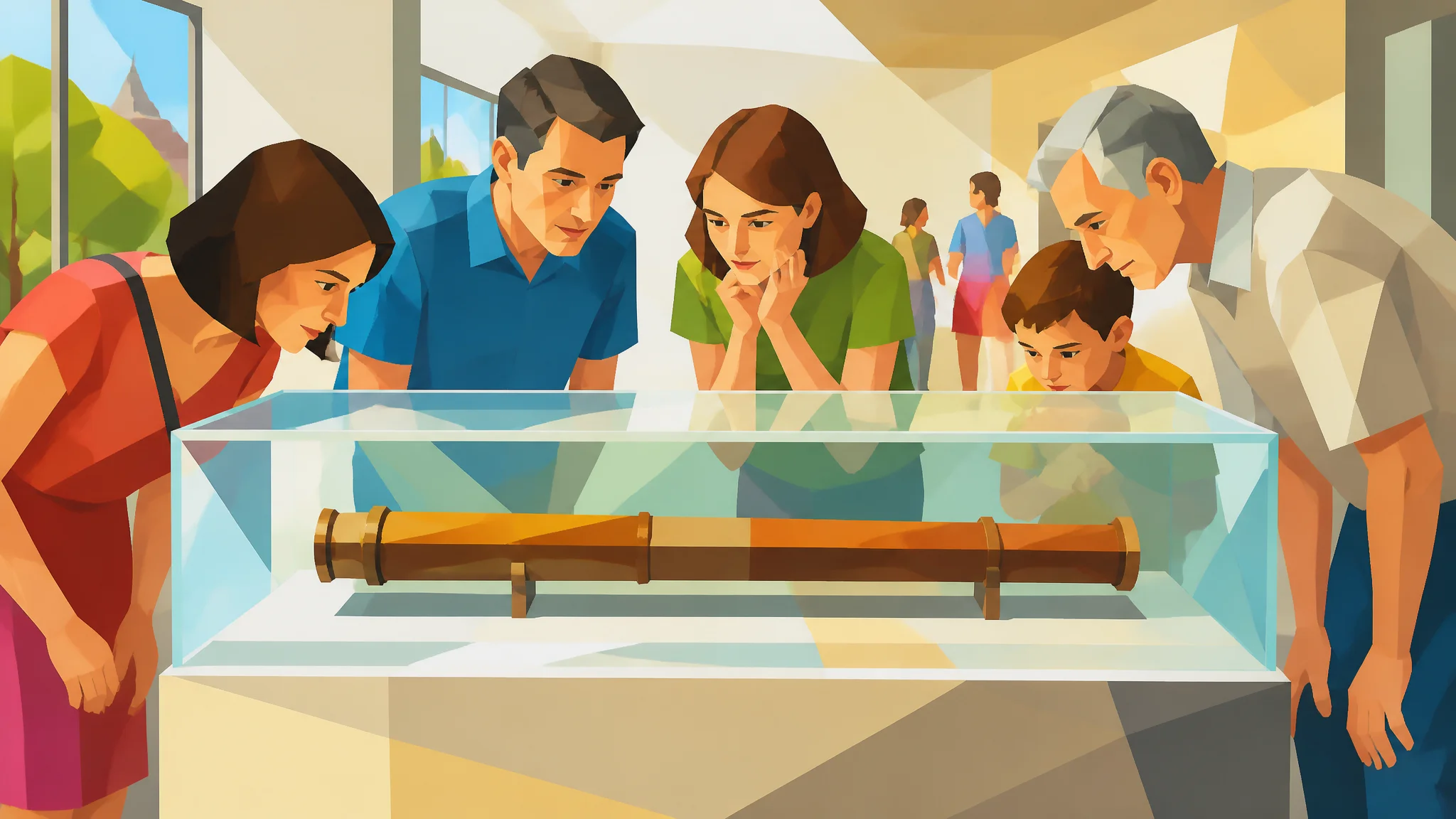
In a quiet room of the Museo Galileo in Florence , a plain tube rests in a glass case . It is only wood , leather , and two small lenses , almost too plain to notice . Yet this modest object is one of Galileo 's own telescopes , and it changed the sky forever . Galileo Galilei did not invent the telescope . Dutch spectacle makers built the first one in 1608 . When the news reached Galileo in Padua , he understood the idea at once . He ground his own lenses and built better versions , until one instrument magnified about twenty times . In August 1609 , he carried a telescope up the bell tower of San Marco in Venice . The senators who climbed with him saw ships far out at sea , hours before the naked eye could find them . For a trading city like Venice , that was worth money , and the Senate rewarded Galileo with a higher salary . Then Galileo did something few people had tried : he pointed the tube at the night sky . He drew mountains and shadows on the moon . In January 1610 , he noticed four small stars in a line beside the planet Jupiter . Night after night , the stars changed position , and Galileo realized they were not stars . Each one was a moon of Jupiter : four moons that circled another world , not the Earth . In March 1610 he published his observations in a small book , Sidereus Nuncius , the Starry Messenger . Scholars across Europe began to argue about the heavens . Today two of Galileo 's original telescopes survive in the Museo Galileo in Florence . Nearby the museum keeps a stranger relic : Galileo 's own middle finger , which admirers removed when his body was moved in 1737 . Visitors pass the famous finger and stop at the plain wooden tube . It fits in one hand ; it once moved the whole sky .