Tap a sentence to see it in Spanish, and tap the book to study it. The speaker plays one sentence, the round button plays a paragraph, and the player at the bottom reads the whole story. Press T to show or hide every translation.
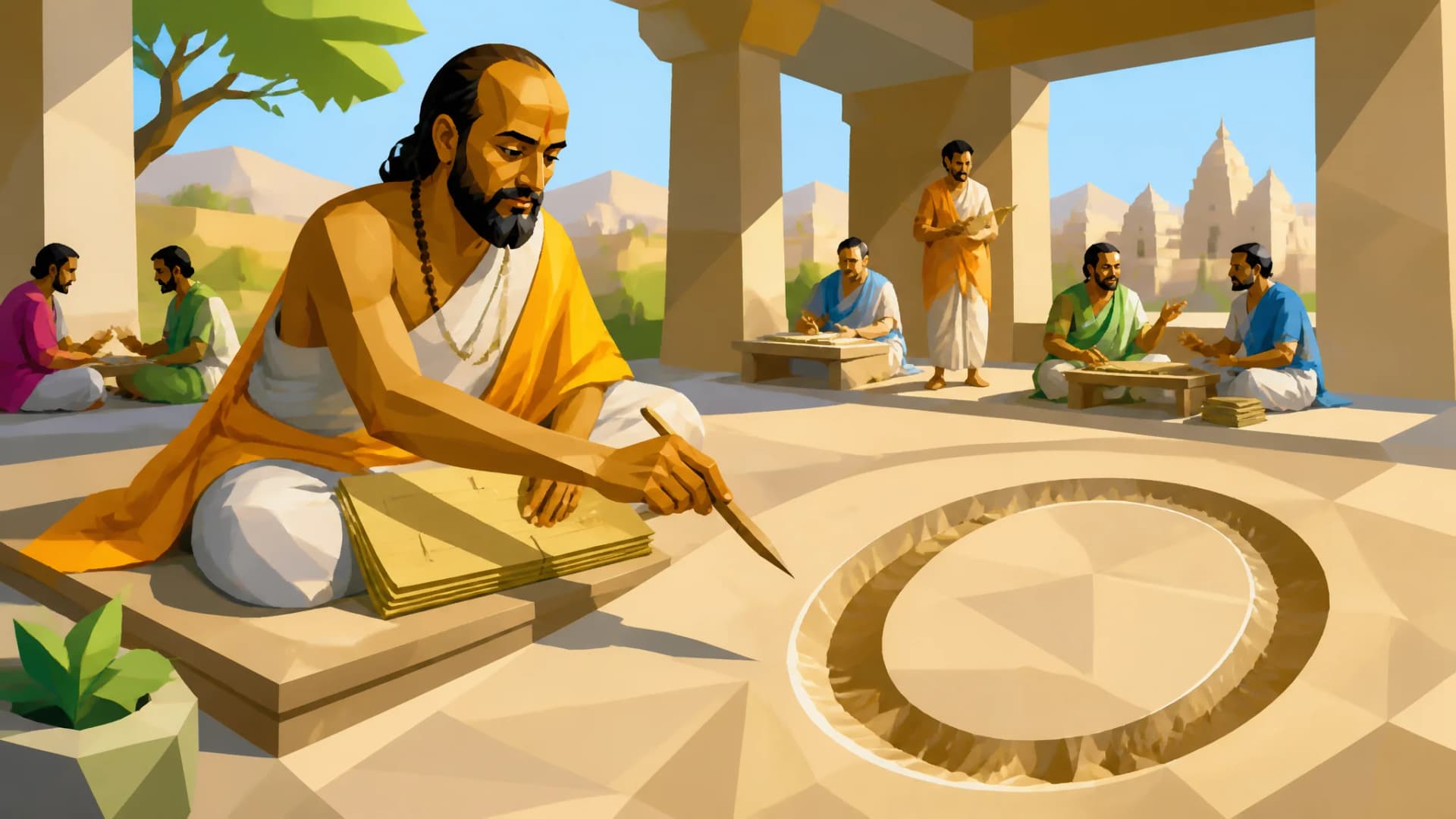
In 628 CE , an Indian mathematician named Brahmagupta sat down in the city of Bhillamāla and wrote a text called the Brāhmasphuṭasiddhānta . Inside it , he laid down the first known rules for calculating with zero . He was not the first person to notice an empty column . Babylonian and Mayan scribes had each used a placeholder symbol to mark a gap in a sequence of digits . But neither culture treated that symbol as a number you could calculate with . He stated that a number added to zero remains unchanged . He stated that a number subtracted from itself produces zero . He stated that any number multiplied by zero gives zero . Writing rules like these made zero a full citizen of arithmetic , not merely a typographical convenience . The consequences spread far beyond India . Arab scholars absorbed Brahmagupta 's system in the 8th and 9th centuries , and figures like Al - Khwarizmi built algebra on top of it . By the 13th century , Leonardo of Pisa — known as Fibonacci — was urging European merchants to adopt the Hindu - Arabic numerals that zero made possible . Roman numerals had no zero , which made long multiplication genuinely cumbersome . Without a true zero , place - value notation collapses . You can not distinguish 11 from 101 . Algebra loses its foundation . And modern computing , which encodes every piece of information as a string of ones and zeros , becomes unthinkable . Brahmagupta 's insight was philosophical as much as mathematical . His insight was that nothing , precisely defined , could be the basis of something .