Tap a sentence to see it in Spanish, and tap the book to study it. The speaker plays one sentence, the round button plays a paragraph, and the player at the bottom reads the whole story. Press T to show or hide every translation.
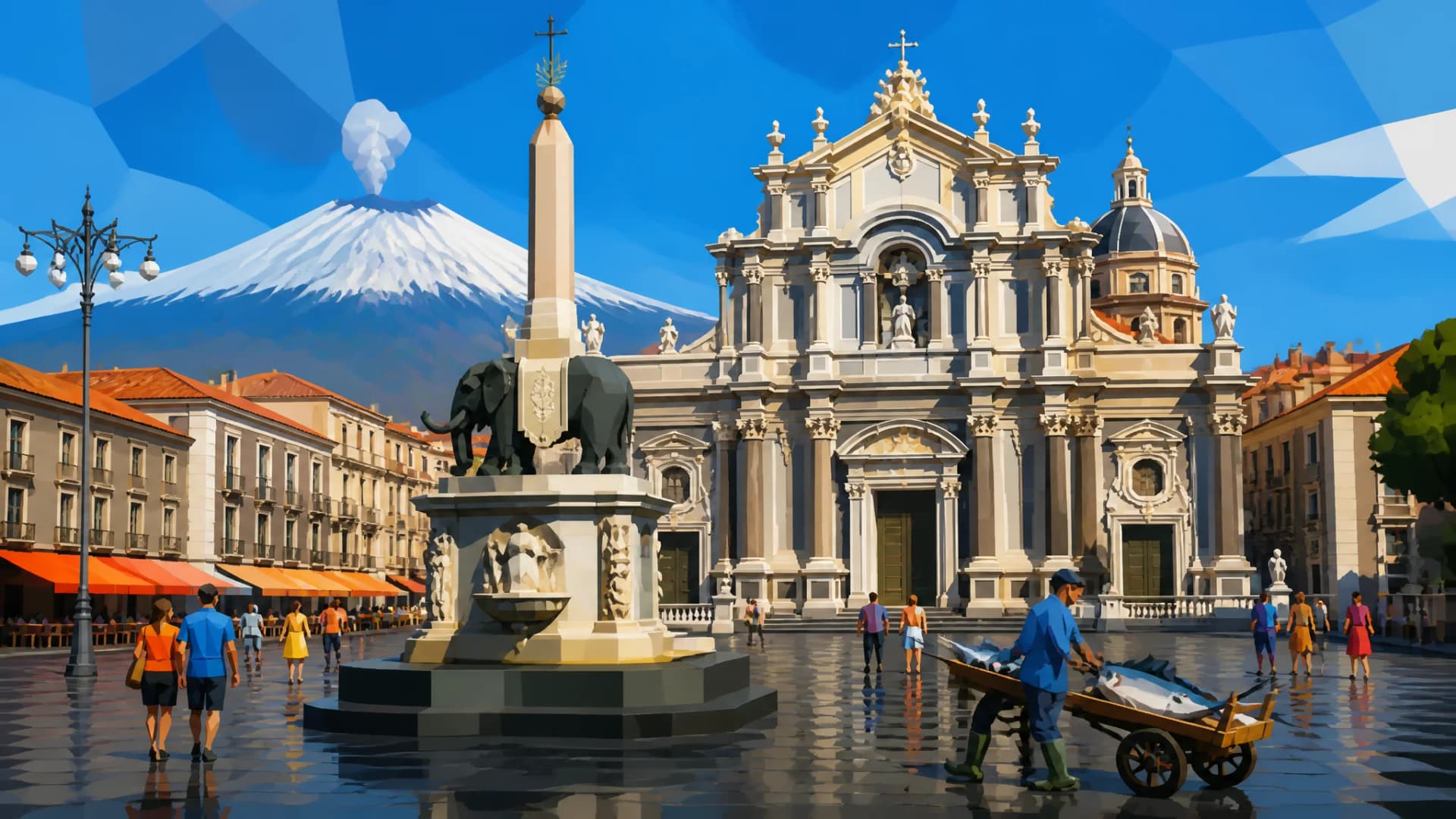
The moment you step off the train at Catania Centrale , in Sicily , southern Italy , the pavement tells you exactly where you are . Every street , staircase and church facade is cut from the same dark basalt that Mount Etna has been pushing out for centuries . Etna , at 3,357 metres , is Europe 's tallest active volcano , and its lower slopes begin just north of the city . More than 200 eruptions are recorded in history , and the stone beneath your shoes is evidence of most of them . Make your way to Piazza del Duomo , the beating heart of the city . The cathedral here dates to 1078 , though earthquakes and lava flows have destroyed and rebuilt it repeatedly . Baroque architects in the 18th century used Etna 's own basalt alongside white limestone . That contrast gives every building around the square a zebra - stripe gravity . At the centre of the piazza stands the Liotru , a lava elephant balancing an Egyptian obelisk on its back . It has served as the city 's emblem for centuries . Get to the Pescheria , the fish market near the port , by six in the morning . The stalls open around five , and by mid - morning the best swordfish and sea urchin are gone . Vendors call across the marble slabs in fast Sicilian dialect , and the salt air and crushed ice sharpen everything . Ash from Etna still dusts windscreens and doorsteps after active periods . Residents sweep it away without drama . Carry that equanimity home with the black stone — it is the city 's true souvenir .