Tap a sentence to see it in Spanish, and tap the book to study it. The speaker plays one sentence, the round button plays a paragraph, and the player at the bottom reads the whole story. Press T to show or hide every translation.
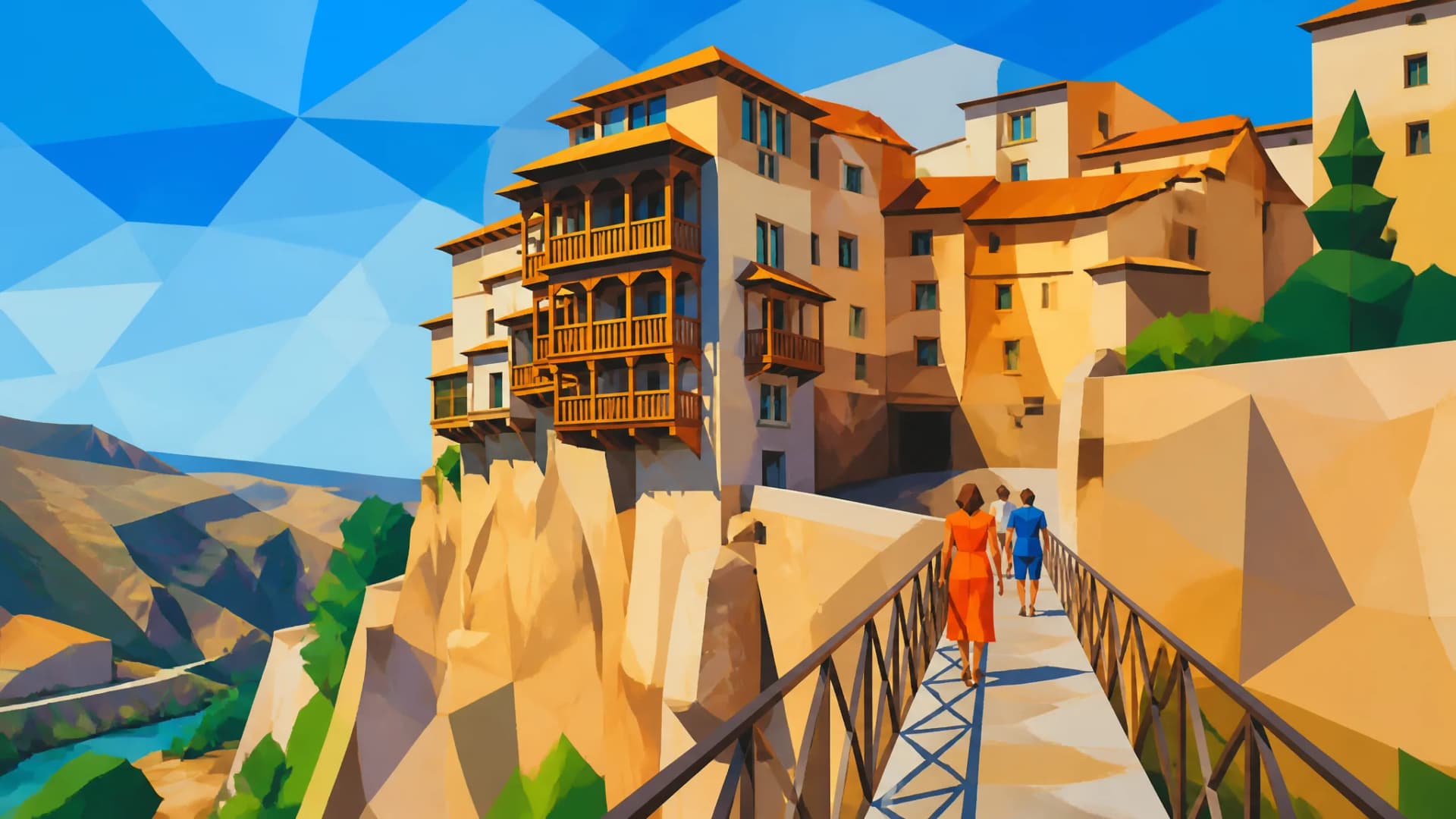
You smell resin and cold limestone first . Then the valley reveals itself . Then Cuenca appears — a medieval city in Castilla - La Mancha , central Spain . It is stacked directly onto the face of a sheer cliff above two river gorges . The houses here are not built near the edge ; they are built over it . Cantilevered on timber frames , they sit above a 40 - metre drop to the Huécar river below . Cross the Puente de San Pablo , a narrow iron footbridge dating to the early twentieth century , and stop at its midpoint . From there you look straight up at the famous hanging houses . Their painted wooden balconies project from the bare rock face as though the cliff itself grew windows . They have occupied that position since the fifteenth century . The old town occupies a narrow ridge enclosed by two rivers , the Júcar and the Huécar . Over millennia , both rivers carved the gorges that make the site possible . Streets climb steeply and tighten to staircases . You can reach the cathedral , built from the twelfth century onward , on foot from the bridge in under 30 minutes . UNESCO inscribed the entire historic city in 1996 . It recognised a place with essentially no flat ground that nonetheless supported a full medieval urban life . Visitor numbers stay modest . On a weekday morning in spring , the cliff - top walkway is nearly empty . Stand there long enough to understand that the drop is real .