Tap a sentence to see it in Spanish, and tap the book to study it. The speaker plays one sentence, the round button plays a paragraph, and the player at the bottom reads the whole story. Press T to show or hide every translation.
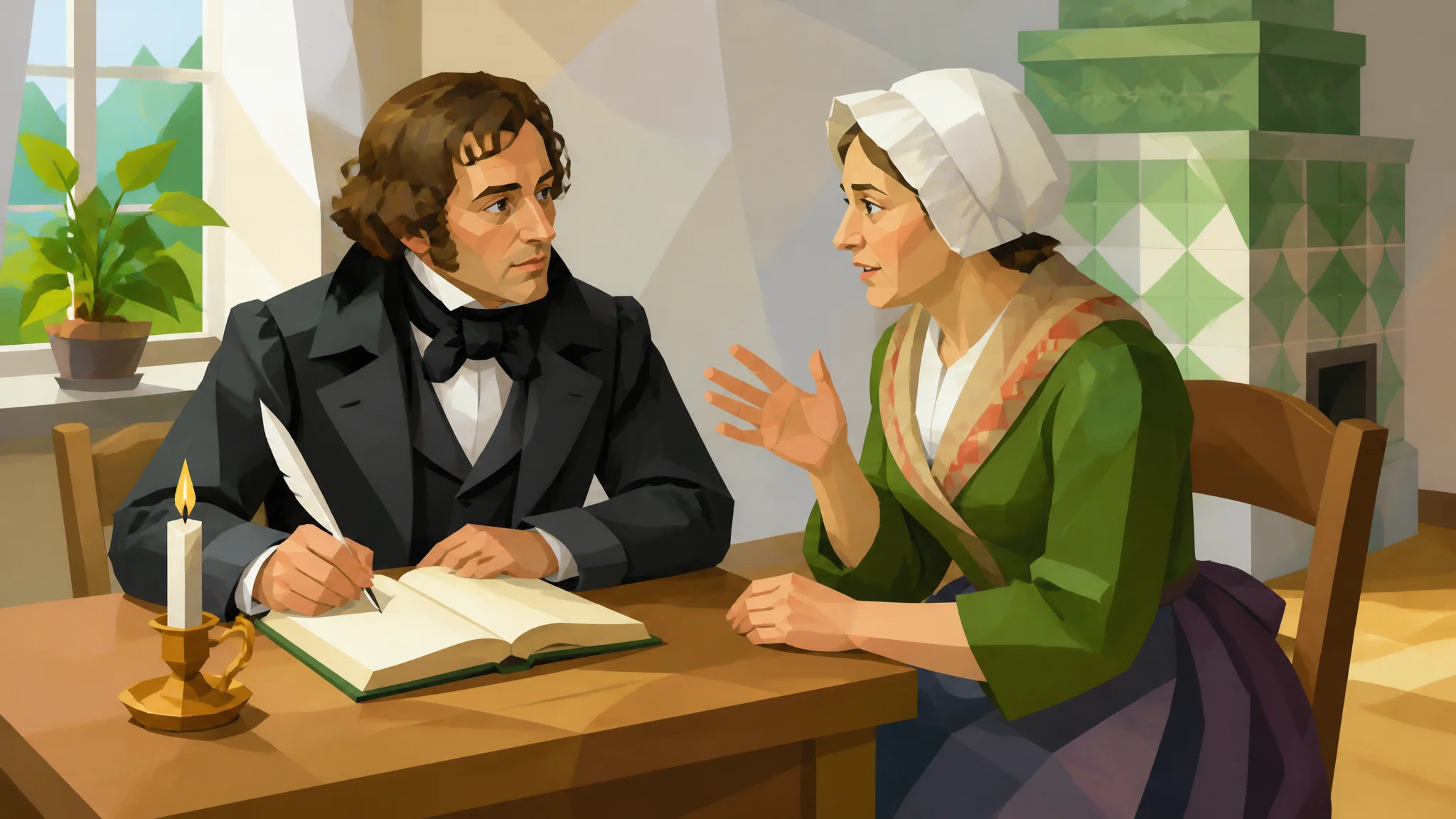
Almost everyone knows the picture : a young man sits under a tree , an apple drops on his head , and suddenly he understands gravity . The young man is Isaac Newton . The real story is quieter . In April 1726 the old Newton had dinner in Kensington , near London , with his friend William Stukeley . Afterwards they drank tea in the garden , under some apple trees . There Newton remembered how the idea of gravity first came to him . An apple had fallen while he was sitting in a garden , deep in thought . Stukeley put this conversation into his memoir of Newton in 1752 , twenty - six years later . Newton placed the apple in 1666 . That date comes from his own memory , about sixty years after the event ; it is not a record written at the time . In those years the plague had closed the University of Cambridge , so Newton had gone home to Woolsthorpe , his family 's farmhouse in Lincolnshire . Stukeley does not mention a blow on the head , and neither does John Conduitt , the husband of Newton 's niece . That detail was added later by other writers . The question , however , was real . Newton asked why the apple always fell straight down to the ground , never sideways or upwards . His answer was that the Earth pulls it . If this pull works at the top of a tree , why not as high as the Moon ? Perhaps the same pull keeps the Moon moving around the Earth instead of flying off into space . His first calculation did not quite work , because he used a wrong figure for the size of the Earth . Later , with better measurements , the numbers agreed . So no apple hit Newton on the head . But an apple in a garden and the Moon in the sky are held by the same pull , and that is the better story .